

What this article covers
Collecting client testimonials is step one. Knowing how to compliantly promote them across every marketing channel where prospects are looking – websites, social media, paid ads, lead nurturing campaigns, online profiles, and AI answer engines – is what will position advisors and wealth management firms to achieve outsized growth for years to come. This comprehensive guide delivers a straightforward playbook with the compliance foundation every advisor needs to put their reviews to work.
Table of contents
If you’ve started collecting online reviews, you deserve a round of applause (assuming you’re doing so compliantly, of course!). You’ve already set yourself apart from the 90% of financial advisors not (yet) using testimonials to accelerate the trust-building process with prospects and establish credibility with Google and and AI search tools like ChatGPT and Gemini.
Now, the question becomes whether your reviews are working as hard for you as they could be. While your online reviews start paying dividends the moment they’re published, their impact is multiplied when you incorporate client testimonials across all of your sales and marketing activities.
That’s what this guide is all about. Whether you’re a solo financial advisor with ownership of your marketing strategy, or in a leadership role of a wealth management firm focused on accelerating organic growth, this guide offers a range of tactics that can be implemented compliantly, whether or not you’ve partnered with Wealthtender as your digital marketing partner and online review platform. Either way, the principles, compliance guardrails, and tactics below are designed to be practical and implementable, most of them this week.
We’re confident this guide will prove valuable in establishing or enhancing your testimonial marketing strategy. If you have questions or feedback, please contact yourfriends@wealthtender.com. We’re always happy to help.
Ready to ramp up your testimonial marketing efforts? Let’s dive in.
Key Takeaways
Promoting a single testimonial requires two additional disclosures beyond the standard three.
When advisors feature one testimonial or a curated selection in marketing materials, the SEC Marketing Rule requires a “not representative” disclosure plus easy access to all (or a representative sample of) reviews. Misunderstanding this rule is a common compliance mistake in testimonial promotion.
Contextually relevant testimonials convert far better than generic ones.
A physician’s review placed inline on an advisor’s landing page about planning services they provide to physicians is exponentially more persuasive than the same review found while scanning a testimonials page. The highest-leverage tactics in testimonial marketing match the content of a review to the context where a prospect encounters it.
Online reviews are a powerful trust signal for AI answer engines.
ChatGPT, Perplexity, Gemini, and Google AI Overviews actively scan for credible trust signals when generating advisor recommendations. With fewer than 10% of advisors using testimonials in their marketing today, advisors who actively collect and publish reviews on the right platforms are positioned to capture a disproportionate share of AI-driven discovery.
Advisors should never promote Google reviews directly, but compliant workarounds exist.
Linking to Google reviews risks violating the SEC Marketing Rule because the platform isn’t designed to display required disclosures, could contain prohibited content and published reviews can be edited by reviewers at any time making the page impossible to supervise. However, images that contain testimonials with required disclosures can be uploaded as photos, offering a compliant path to display testimonials within a Google Business Profile
Why Promoting Testimonials Matters More Than Ever
The case for proactively promoting client testimonials has only gotten stronger this year, for three reasons that compound on top of one another.
1. Consumers preparing to hire advisors expect to find reviews online. Our August 2025 Wealthtender consumer study found that 83% of consumers rank online reviews as the first thing they look for after being referred to a financial advisor. Almost all Americans research at least two advisors online before making a hiring decision. When fewer than 10% of advisors have client reviews published online, simply having reviews is a competitive moat.
2. Search engines reward authentic social proof. Google’s quality raters are explicitly instructed to consider third-party reputation signals when evaluating Your Money or Your Life (YMYL) business websites, and financial advisor sites are textbook YMYL (e.g., businesses that offer services that could positively or negatively impact the health or finances of individuals). Client testimonials published on your website help, but online reviews on independent, third-party platforms like Wealthtender send stronger trust signals into the algorithms that influence who appears near the top of search results.
3. AI answer engines are the fastest-growing discovery channel, and they read reviews. ChatGPT, Perplexity, Gemini, Claude, and Google AI Overviews are increasingly the tool used by prospects to find and research advisors. These tools actively look for trust and reputation signals when generating advisor recommendations. As FMG Chief Evangelist Samantha Russell often emphasizes, online reviews are one of the most important inputs into an effective Answer Engine Optimization (AEO) strategy.
There’s also a cross-cutting principle that ties all of this together: review context matters, perhaps even more than review quantity. A dedicated website page that links to “all reviews” serves a useful marketing purpose and plays a compliance role, too. A landing page about your retirement planning services for physicians that features a review from a physician – placed inline at the moment of greatest reader intent – is contextually relevant and packs a powerful punch. Throughout the tactics that follow, watch for opportunities to match the content of a testimonial to the context in which a prospect encounters it. That’s where promotion turns into persuasion.
The Compliance Foundation: What You Must Know Before You Promote
Before implementing any tactic below, every advisor must understand the regulatory expectations that apply the moment you encourage a prospect to engage with a client review, whether individually, in a social media post, or any other form of promotion. This section is dense by necessity, but knowledge is power. By understanding your regulatory and compliance obligations, you gain a marketing tailwind to feel confident about your ability to execute every tactic in this guide compliantly and with confidence. Of course, this guide is offered for educational purposes only and it’s important to always consult your compliance counterpart for their guidance as you ramp up your testimonial marketing efforts.
When Does Promotion Trigger the SEC Marketing Rule? (Adoption and Entanglement Explained)
The SEC Marketing Rule states that once you have “explicitly or implicitly endorsed or approved” an online review after its publication, you have adopted that review and the review becomes an advertisement subject to the rule’s prohibitions and disclosure requirements.
In practical terms, the moment you point a prospect to a review, link to a review(s) from your website, share a testimonial on social media, or feature client feedback in a flyer, the disclosure rules apply. Don’t assume there are any exceptions… you know what they say when you ass-u-me.
The Three “Clear and Prominent” Disclosures
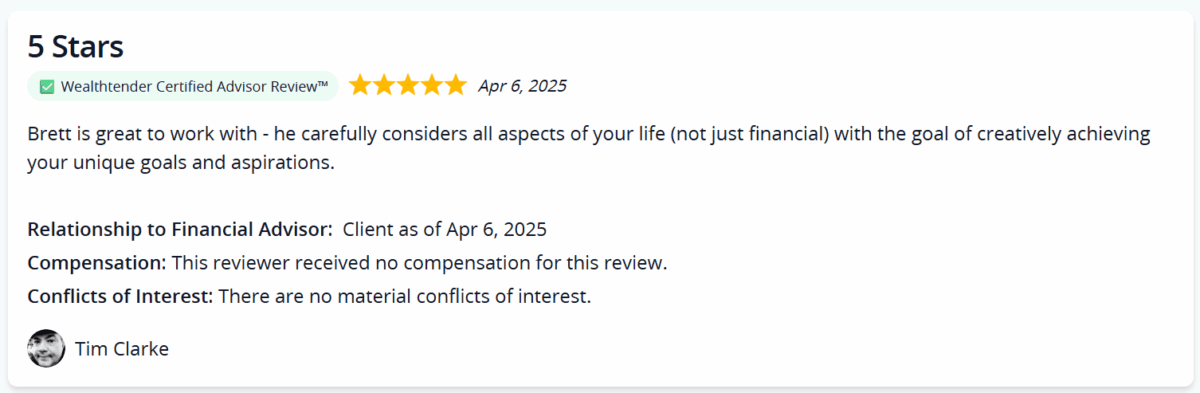
Every promoted testimonial must clearly and prominently disclose:
- Whether the reviewer is a current client or a non-client
- Whether any cash or any non-cash compensation was provided for the review.
- Any material conflicts of interest that may have influenced the reviewer.
“Clear and prominent” means the same font size as the review itself, visible alongside the review, and not hidden behind a link. These disclosures effectively become part of the review (and is exactly why every review published on Wealthtender always displays these three disclosures).
Additional Disclosures Required for Promoted Testimonials
Beyond the clear and prominent disclosures, the SEC requires additional disclosures explaining:
- The material terms of any compensation arrangement with the reviewer (if applicable), including the amount (or value, if non-cash), the time period for any fee reductions, and the percentage of the discount.
- A detailed explanation of any material conflicts of interest.
Unlike clear and prominent disclosures, these additional disclosures may be delivered through a hyperlink, a separate disclosure document, or similar mechanism, they don’t have to live directly alongside the review itself.
For comprehensive guidance on crafting compliant disclosures, see our companion guide: SEC Marketing Rule & Testimonials: Crafting Your Disclosures.
Promoting a Single or Curated Selection of Testimonials
This is where many advisors get tripped up — and it’s an area where compliant promotion offers some of the most impactful benefits once you understand the mechanics.
When you display just one testimonial or a curated selection in any marketing piece (a social media post, a homepage carousel, a printed flyer, an inline blog quote, a postcard), two additional requirements kick in beyond the clear and prominent disclosures:
- A disclosure that the featured review(s) are not representative of the experiences of other clients.
- Easy access for the consumer to view all (or a representative sample) of your reviews (e.g., often by including a link or QR code to a dedicated testimonials page on your website or Wealthtender profile that displays your complete review history with regulatory disclosures.
The logic is straightforward: the SEC wants to prevent the cherry-picking of reviews from misleading prospects. If you’re only showing your best feedback, consumers deserve a clear path to see the full picture.
Illustrative disclosure language for a single-testimonial social media post (for example only — review with your CCO and adapt to your specific circumstances):
This testimonial is from a current client who received no compensation and where no material conflicts of interest exist. The views expressed are individual to this client and may not be representative of the experience of other clients. Read all reviews at [link or QR code].
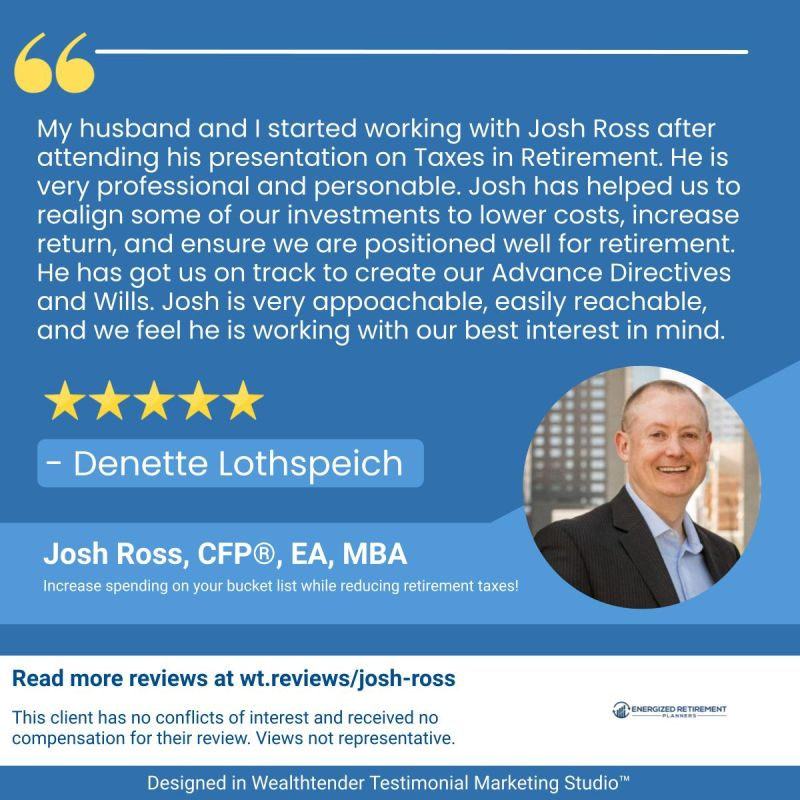
Example of a compliant social media post displaying a single testimonial. The three ‘clear and prominent’ disclosures are conveyed in the first sentence within the disclosure area. The second sentence addresses the ‘views not representative’ disclosure requirement. And the ‘Read more reviews…’ statement satisfies the regulatory requirement to provide consumers with an easy ability to access and read all reviews for this advisor, available by visiting the URL: wt.reviews/josh-ross
Illustrative disclosure language for a curated carousel of three testimonials on your homepage (for example only — review with your CCO):
The testimonials displayed above are from current clients who received no compensation and where no material conflicts of interest exist. The views expressed are individual to each client and may not be representative of the experience of other clients. View all client reviews on our Wealthtender profile page or dedicated testimonials page.
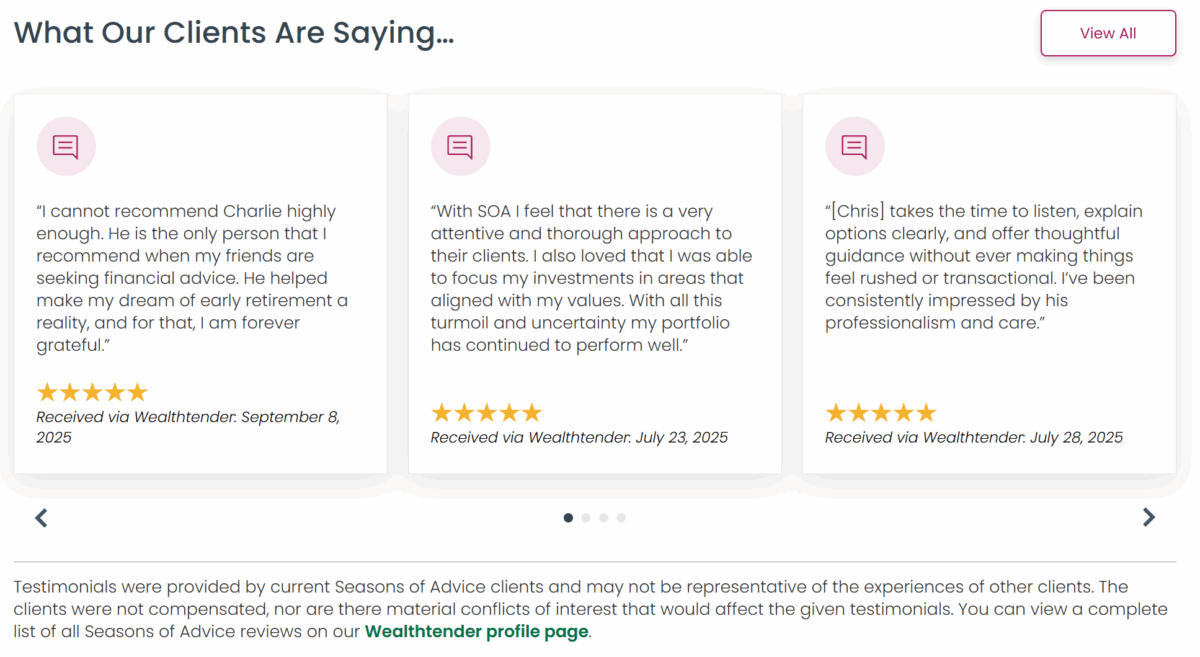
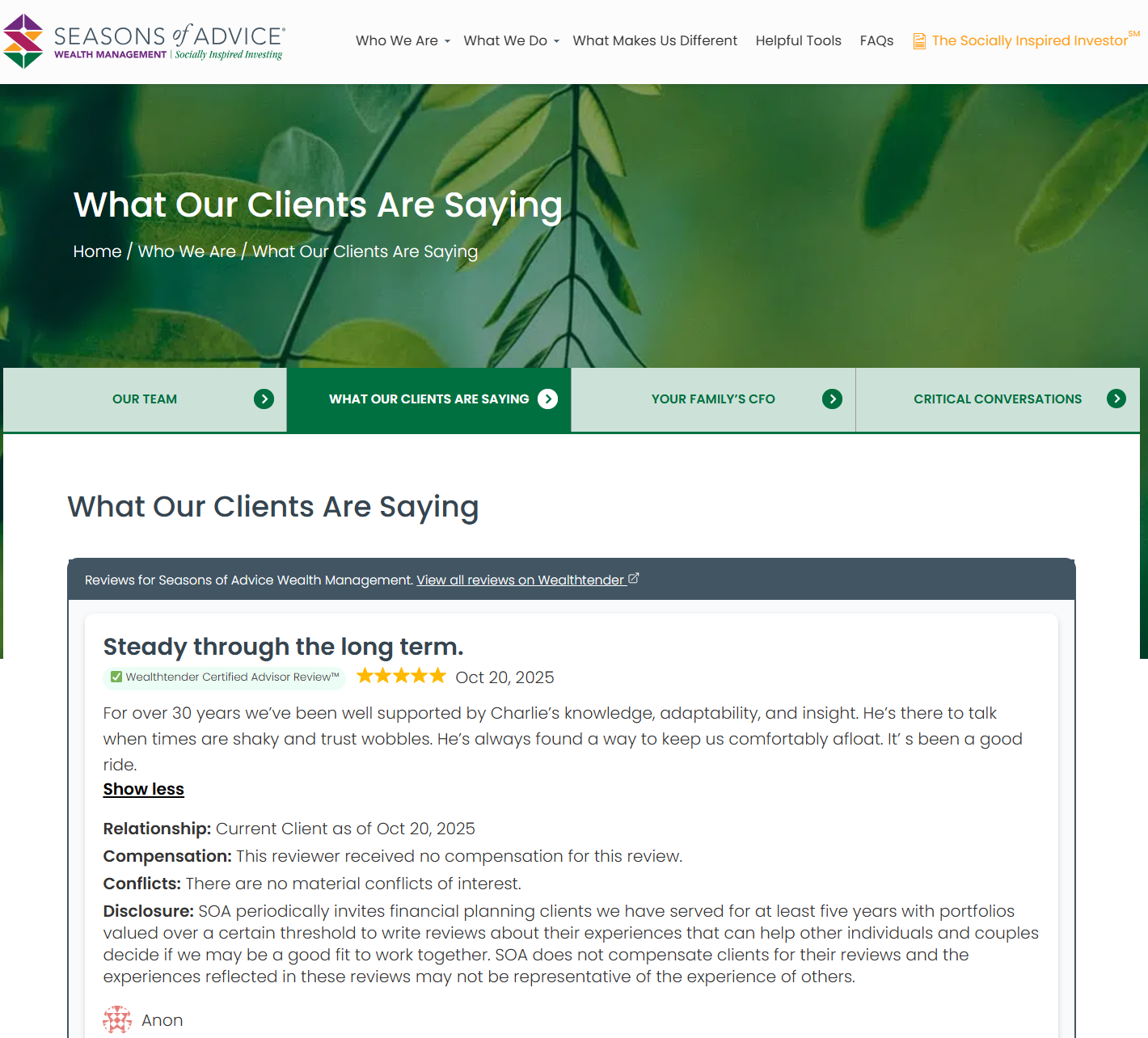
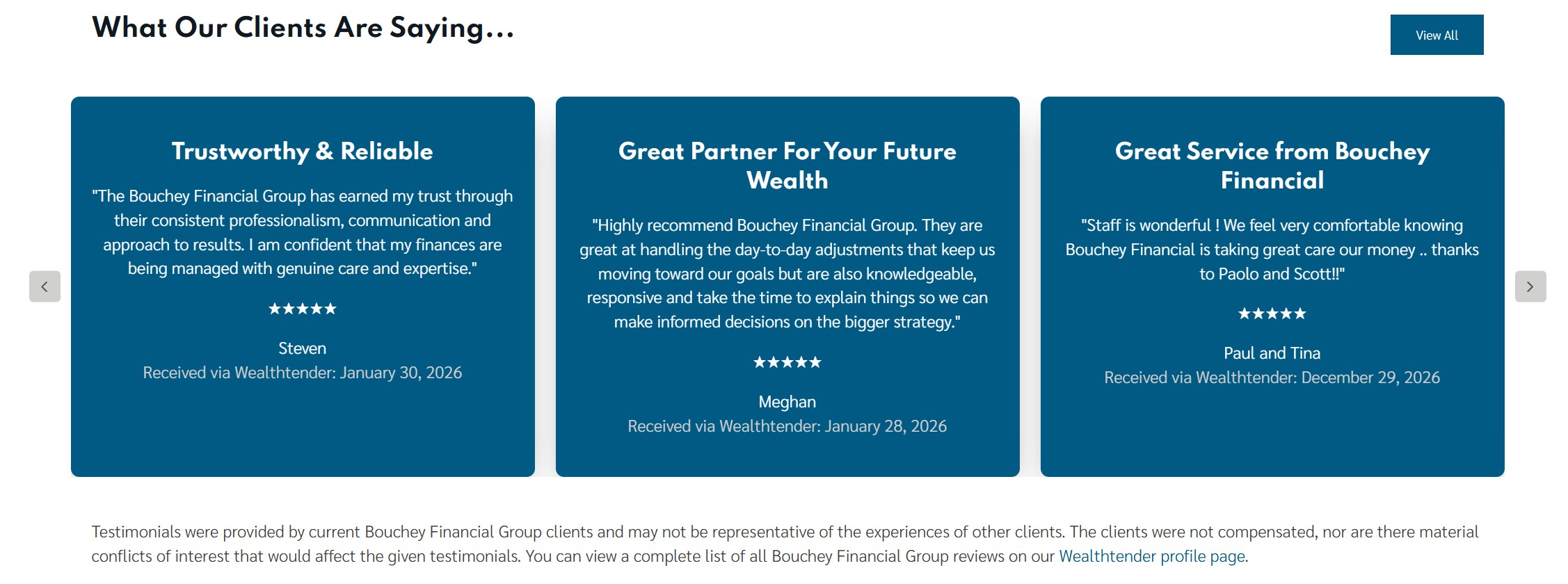
Example of a compliant carousel feature displaying a curated selection of testimonials on the homepage of an advisor’s website. The three ‘clear and prominent’ disclosures are conveyed in the first two sentences within the disclosure area. The first sentence also addresses the ‘views not representative’ disclosure requirement. And the last sentence lets consumers know where they can go with a link to read a complete list of all of the firm’s reviews “on our Wealthtender profile page”. Screenshot from soawealth.com
For a deeper look at how this plays out in practice, including examples of advisors doing it well, see our guide on how to display testimonials on financial advisor websites.
Where You Can and Can’t Direct Prospects
A bright-line rule worth tattooing on your forehead (or monitor): never direct prospects to “read our Google reviews” or link to general review websites. The moment you link to a general review platform, the SEC could deem it an advertisement of your firm, triggering disclosure requirements difficult to administer and responsibilities for ensuring no promissory language or prohibited content exists on the page. Even if your reviews on those platforms are favorable and authentic, promoting them (or linking to them) is off-limits under the Marketing Rule. It’s also one of the reasons Wealthtender offers a Google Review Import tool to turn non-compliant reviews into compliant testimonials that can be promoted and properly administered.
Compliant destinations to promote your reviews are platforms where the required disclosures live alongside each review, including:
- Your own website (with disclosures implemented properly)
- Your Wealthtender profile page
- Embedded Wealthtender widgets on third-party sites (where applicable)
Considerations for State-Registered Advisors
If you’re a state-registered investment advisor (rather than SEC-registered), the first step is to confirm whether your state regulator has granted approval for RIAs in your state to ask for and promote testimonials. As of today, most states permit state-registered advisors to collect and publish reviews by following the SEC Marketing Rule framework, but not all yet do. Confirm with your state regulator before implementing any tactic in this guide. You’ll find a current snapshot of state regulator feedback compiled by Wealthtender in our state regulator tracking database.
Considerations for Dually-Registered Advisors Under FINRA
If you’re a hybrid or dually-registered advisor subject to FINRA oversight, you must concurrently satisfy FINRA Rule 2210(d)(6) when promoting testimonials. The good news: FINRA’s requirements fit easily within the SEC Marketing Rule framework.
For testimonials, FINRA additionally requires prominent disclosure of:
- The fact that the testimonial may not be representative of the experience of other customers,
- The fact that the testimonial is no guarantee of future performance or success, and
- If more than $100 in value was paid for the testimonial, the fact that it is a paid testimonial.
These FINRA-specific disclosures can be incorporated alongside your SEC-required disclosures in a single block. For technical reviews, FINRA also expects the reviewer to have the knowledge and experience to form a valid opinion.
Testimonial Promotion Tactics: A Three-Tier Framework
The testimonial marketing tactics below are organized in three tiers based on effort, reach, and the time horizon over which they pay off. If you do nothing else, start with the tactics in Tier 1 first. Tier 2 is where compounding starts. Tier 3 is where you can truly separate yourself from everyone else.
Tier 1: Quick Wins (Implement This Week)
These are the low-effort, high-visibility tactics that nearly any advisor with reviews on Wealthtender (or a compliant website) can implement today.
1. Add a “Read My Reviews” link to your email signature. Every email you send to prospects and COIs becomes a passive testimonial promotion opportunity. Link to your Wealthtender profile or your dedicated testimonials page where all of your reviews are displayed with accompanying disclosures. Zero ongoing effort; touches every interaction. Even your existing clients who click and see their own words or those shared by others reinforces their loyalty and sense of conviction that they’ve picked the right partner.
2. Add a reviews link to email auto-responders, calendar booking confirmations, and intake emails. Prospects who have just booked a discovery call are at peak research intent. A line in your booking confirmation like “Before we meet, here’s what other clients have shared about their experience working with us: [link]” captures their interest and steers feelings of uncertainty towards an increasing sense of conviction that their instincts to reach out are right.
3. Use your Wealthtender QR code in printed materials and business cards. Wealthtender subscribers have access to a personalized QR code that links directly to their Wealthtender profile page. Print it on business cards, brochures, conference handouts, even your office signage. It bridges every offline introduction to your full page of social proof.
4. Embed a Wealthtender review widget on your website displaying all your reviews. This is the easiest plug-and-play way to compliantly display reviews on your home page and bio page. Because the widget displays your complete review history (not a curated subset), it automatically satisfies the “representative sample” requirement, no additional linking required. Both JavaScript and iframe widget options are available from your Wealthtender dashboard under Embed Codes.
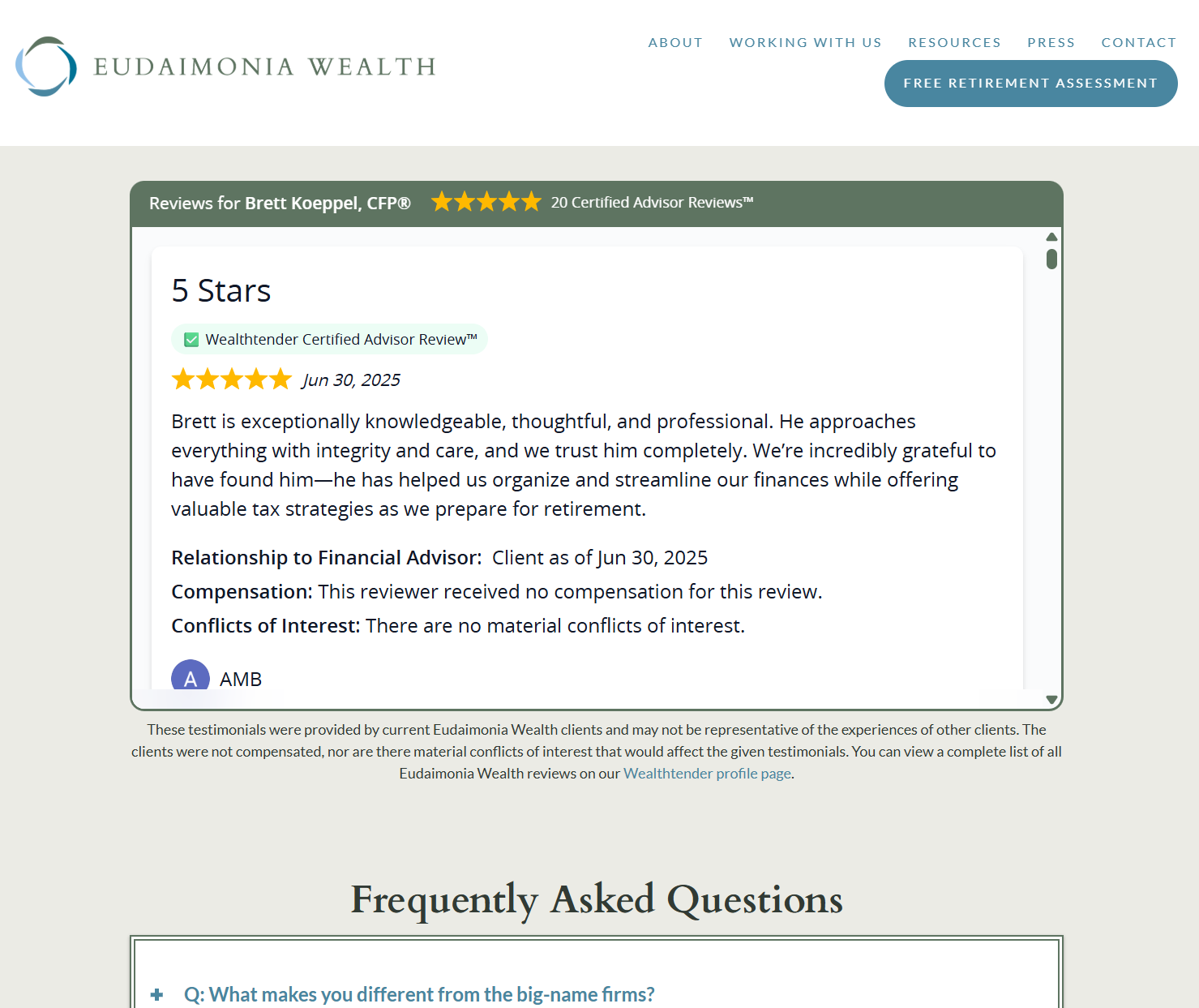
5. Add a dedicated /reviews or /testimonials page to your website. Gives prospects a destination, gives SEO a target page, and gives you the URL you’ll link to in social posts, printed materials, and ads as the “representative sample” link as an alternative to linking to your Wealthtender profile. Use a Wealthtender widget for automatic updates.
6. Update your LinkedIn “About” section, Featured section, and Services section with a reviews link. Many prospects research advisors via LinkedIn before scheduling. Make sure your reviews are one click away from your profile.
7. Upload compliant testimonial image graphics to your Google Business Profile and/or LinkedIn Profile. This is an underused tactic in advisor marketing. While you can’t promote your Google Reviews directly, you can upload branded image graphics showcasing a testimonial – designed with the required disclosures baked into the image itself – as “photos” on your Google Business Profile. Wealthtender’s Testimonial Marketing Studio makes this easy or you can create compliant images yourself in a tool like Canva by adding the proper disclosures. The image becomes a persistent, compliant testimonial in a high-visibility property you already own. Similarly, you can implement a similar approach on your LinkedIn profile by adding a testimonial graphic with compliant disclosures as a featured post.
Tier 2: Intermediate Plays (Compounding Returns)
These tactics require ongoing effort or process, but they’re where testimonial marketing starts meaningfully moving the needle on lead volume and conversion.
1. Single-testimonial social media posts (the cornerstone tactic). A well-designed social media post featuring a single client testimonial with required disclosures is one of the most effective promotional formats in modern advisor marketing. The challenge most advisors face isn’t the idea, it’s understanding the disclosure particulars. For Wealthtender subscribers, Testimonial Marketing Studio handles disclosure layout automatically across a growing library of professionally designed templates.
Create scroll-stopping social media posts that satisfy compliance requirements in just two minutes.
To view this LinkedIn post and other social media posts that include projects created in Testimonial Marketing Studio, please click here.
2. A curated testimonial carousel on your homepage (3–5 reviews). Particularly popular among multi-advisor firms. Display a rotating selection of standout reviews with the required “not representative” disclosure and link to your full reviews immediately below the carousel. Prioritize reviews whose content aligns with your Ideal Client Profile.
3. Contextually relevant testimonials placed inline on service pages and niche landing pages. This is among the highest-leverage tactics in the entire guide. If you have a landing page on specialized services you provide like retirement planning for physicians, a single testimonial from a physician praising your work on that exact topic is exponentially more persuasive than a generic review and validates that what you say about your expertise in your own words is backed up by clients saying it in theirs. Same for business owners visiting your exit planning page, women visiting your widow/divorce transition page, or executives visiting your equity compensation page. The testimonials on these pages provide social proof at the precise moment of intent, and using Studio designs offers an easy way to handle the inline disclosure layout cleanly.
4. Contextually relevant testimonials embedded inline in blog articles. Apply the same principle to your content marketing. An article about funding a child’s college education becomes substantially more persuasive with an inline testimonial from a parent praising your education-funding work. An article on tax-efficient retirement income gains weight with a retiree’s review. Treat every blog post as an opportunity to ask: “Do I have a review that proves this expertise in a client’s own words?”
5. Niche-specific lead nurturing campaigns featuring testimonials from clients in that niche. Generic nurture sequences underperform compared to niche-specific sequences featuring social proof from clients who look like the prospect. A nurture sequence for “women navigating divorce” that surfaces reviews from women you’ve helped through divorce converts at a different rate entirely. Pairs naturally with your niche landing pages.
6. Reviews in newsletters and prospect drip campaigns. Rotate a featured client review (with disclosures and a link to your full set) into your email newsletter cadence. Re-engages existing audience and warms prospects already in your funnel.
7. Reviews in seminar and webinar marketing. Include a relevant testimonial in the seminar invitation email. Display testimonials on slides during the event or printed on flyers provided to attendees upon their arrival. Send a post-event follow-up that includes a relevant review with appropriate disclosures. Seminars and webinars often attract cold prospects – Your testimonials quickly close the trust gap and warm up the room.
8. Testimonials embedded as proof points inside educational webinar content. Don’t relegate testimonials to the opening or closing of webinars – weave them in as evidence at the moment a particular benefit or service is discussed. After explaining tax-loss harvesting, briefly display and read a review from a client who benefited from it. After describing your retirement income planning approach, share a testimonial from a retiree client. This is the webinar equivalent of inline contextual placement on a landing page.
9. Reviews in printed prospect kits, neighborhood postcard mailings, and pre/post-seminar flyers. Online reviews don’t have to stay online. A postcard mailing to a target neighborhood featuring a testimonial from a nearby client is highly impactful. A flyer at an educational seminar (or mailed to seminar attendees afterward) featuring a contextually relevant testimonial reinforces the trust built in person. QR codes make compliance straightforward (link to all reviews).
10. Repurpose written reviews into short video assets. Audio of the review (or text-on-screen animations of the review) with disclosures rendered on screen. Video gets disproportionate algorithmic reach on LinkedIn and Facebook. Studio templates support the creation of animated graphics, or consider using tools like Canva or partnering with a marketing agency who can offer professional support.
11. Ask third-party directories where you’re listed to embed your Wealthtender reviews. Your Wealthtender reviews are portable. Just as you’re able to use Wealthtender widgets to compliantly display client reviews on your website, if you’re listed on other advisor directories, ask each one if they will embed your Wealthtender reviews on your profile. By sharing your Wealthtender widget embed code, the process shouldn’t take more than 5 minutes for your reviews to be displayed. This ensures your reviews work for you across each of the platforms where prospects are most likely researching you, increases click-through rates and improves the effectiveness of all of your online profiles to generate more introductory calls.
Tier 3: Advanced & Sustained Testimonial Marketing Tactics (Market Leadership)
These are the initiatives implemented by advisors likely to experience the greatest growth over the next decade from those who take a more passive approach with their testimonials.
1. Build a recurring testimonial content series. A weekly “Testimonial Tuesday” or “Five Star Friday” campaign on LinkedIn (or whatever frequency and platform fits your marketing mix) builds a library of compliant assets, establishes consistency, and signals confidence to prospects and algorithms alike. Consistency beats episodic effort, and the cadence itself becomes a brand signal.
2. Identify your “biggest fans” for deeper-format content. As your testimonial library grows, you’ll discover which clients are most enthusiastic. These are candidates for long-form content: a podcast interview about their experience, a written Q&A case study, a longer-form video testimonial (tip: their online review offers a great starting point for a script). Long-form social proof converts the most skeptical prospects and creates assets that work for years.
3. Compliantly use testimonials in paid advertising. Google Ads, Meta Ads, and sponsored LinkedIn content can all incorporate testimonials when structured with proper disclosures. This tactic is rare in advisor marketing precisely because so few advisors understand the disclosure requirements, which is exactly why it’s a competitive opportunity.
4. Layer testimonials with awards, press, and earned media. If you or your firm has earned a Wealthtender Voice of the Client Award for consistently exceptional reviews, layer that recognition on top of your individual testimonials. See our companion guide on how to promote your Voice of the Client Award for tactics specific to award promotion.
5. Train every client-facing team member to incorporate testimonials in communications. Marketing tactics fall short when your entire team isn’t enlisted to execute them in a coordinated manner. A 30-minute internal training that walks every team member through where reviews live, how to point prospects to them, and what compliance guardrails apply turns your entire team into testimonial promoters.
6. Conduct a testimonial integration audit across every marketing channel. This is the capstone tactic and the framework that ties everything together. Map every prospect touchpoint your firm operates (e.g., website pages, email sequences, paid ads, lead generation platforms, intake workflows, proposal templates, voicemail follow-ups, even your physical office) and ask of each: “Where could a contextually relevant testimonial plug in here and how could it magnify our marketing?”
This audit is especially valuable for advisors using paid lead generation platforms like SmartAsset. When ~90% of advisors lack any reviews whatsoever, including a relevant testimonial in your cold lead nurturing emails immediately distinguishes you from other advisors competing concurrently for the very same lead. For a deeper dive into this topic, check out our related article: How Financial Advisors Using SmartAsset Can Drive Greater ROI with Wealthtender.
The audit also becomes the framework for your testimonial marketing prioritization roadmap, a living document that should be revisited quarterly.
Testimonial Promotion Playbook
Your Prioritized Action Plan
| Tier | Tactic | Why It Matters | Effort |
|---|---|---|---|
| ⚡ Tier 1 — Quick Wins (Implement This Week) | |||
| T1 | Add a “Read My Reviews” link to your email signature | Every email becomes passive testimonial promotion. Zero ongoing effort; touches every client, prospect, and COI interaction. | Low |
| T1 | Add reviews link to auto-responders & booking confirmations | Captures prospects at peak research intent — right after they book a discovery call and are most receptive to social proof. | Low |
| T1 | Use your Wealthtender QR code in printed materials | Bridges offline introductions — business cards, brochures, office signage — to your full body of online social proof. | Low |
| T1 | Embed a Wealthtender widget displaying all reviews on your website | The easiest compliant homepage option. Displaying all reviews automatically satisfies the “representative sample” requirement. | Low |
| T1 | Build a dedicated /reviews or /testimonials page | Gives prospects a destination, gives SEO a target page, gives you the URL to use as your “representative sample” link. | Low |
| T1 | Update LinkedIn About, Featured, and Services with reviews link | Many prospects research advisors on LinkedIn before scheduling. Make your reviews one click from your profile. | Low |
| T1 | Upload a compliant testimonial image to your Google Business Profile | Underused workaround that adds compliant testimonial content to a high-visibility property. | Low |
| 📈 Tier 2 — Intermediate Plays (Compounding Returns) | |||
| T2 | Single-testimonial social media posts (with disclosures) | The cornerstone modern tactic. Testimonial Marketing Studio handles disclosure layout so advisors can focus on the story. | Medium |
| T2 | Curated testimonial carousel on homepage (3–5 reviews) | High-impact homepage placement. Prioritize reviews aligned with your Ideal Client Profile for maximum conversion lift. | Medium |
| T2 | Place contextually relevant testimonials inline on niche landing pages ⭐ | Among the highest-leverage tactics in the guide. A physician’s review on your physician landing page is E-E-A-T evidence at the moment of intent. | Medium |
| T2 | Embed contextually relevant testimonials inline in blog articles ⭐ | A college funding article paired with a parent’s review of your college planning work is proof-in-context. Multiply your content’s persuasion. | Medium |
| T2 | Build niche-specific lead nurturing campaigns featuring relevant testimonials | A “women in transition” sequence featuring reviews from women you’ve helped converts at a different rate than a generic sequence. | Medium |
| T2 | Rotate featured reviews into newsletters and prospect drip campaigns | Re-engages your existing audience and warms prospects already in your funnel without adding new content overhead. | Medium |
| T2 | Integrate testimonials into seminar & webinar marketing | Closes the trust gap with cold prospects within a single engagement window. Use video clips as inline proof points during the event. | Medium |
| T2 | Print testimonials in prospect kits, neighborhood postcards, and seminar flyers | Online reviews don’t have to stay online. Offline channels often have less competition for prospect attention; QR codes keep them compliant. | Medium |
| T2 | Repurpose written reviews into short video assets | Video gets disproportionate algorithmic reach on LinkedIn and Meta. Use online tools or partner with a marketing agency to turn written reviews into animated video testimonials. | Medium |
| T2 | Ask third-party directories to embed your Wealthtender reviews | Wealthtender reviews are portable. Expand your social proof surface area across every directory listing you have. | Low |
| 🚀 Tier 3 — Advanced & Sustained Programs (Market Leadership) | |||
| T3 | Build a recurring testimonial content series (“Testimonial Tuesday”) | Consistency beats episodic effort. Establishes a content cadence and builds a library of compliant assets over time. | High |
| T3 | Activate your biggest fans for deeper-format content (podcasts, Q&As, video) | Long-form social proof converts the most skeptical prospects and creates assets that work for years. | High |
| T3 | Compliantly use testimonials in paid advertising | Rare among advisors precisely because the disclosure mechanics intimidate most firms — which is exactly why it’s a competitive opportunity. | High |
| T3 | Integrate testimonials into your AI/AEO discovery strategy | Reviews are among the strongest ranking signals AI tools use when recommending advisors. The fastest-growing discovery channel rewards review presence. | Medium |
| T3 | Layer testimonials with awards, press, and earned media | Multiple authority signals compound. A Voice of the Client Award stacked on top of individual testimonials reinforces credibility. | Medium |
| T3 | Train every client-facing team member to reference testimonials in communications | Marketing tactics fall short when the full team isn’t engaged. A 30-minute internal training turns the whole team into testimonial promoters. | Low |
| T3 | Conduct a testimonial integration audit across every marketing channel ⭐ | The capstone tactic. Map every prospect touchpoint and identify where contextually relevant testimonials belong. Especially valuable for paid lead gen platforms like SmartAsset. | Medium |
⭐ = Highest-leverage tactics, where contextual relevance multiplies conversion impact. Effort ratings reflect time-to-implement; impact compounds over time as your library of compliant assets and prospect touchpoints grows.
Compliance Pitfalls: What Many Advisors Get Wrong
Even advisors with strong intentions stumble on these common pitfalls. Watch out for each.
1. Linking to your Google or Yelp reviews from marketing materials. Never. Those platforms don’t display the required regulatory disclosures, could contain content prohibited by the SEC Marketing Rule that is difficult to remove, and published Google reviews can be edited by a reviewer at any time, making supervision of the page as an advertisement virtually impossible.
2. Replying to reviews on Google or Yelp. The act of replying may trigger “adoption” of the underlying review under the SEC’s framework, subjecting it to disclosure requirements those platforms aren’t designed satisfy and subject to the shortcomings referenced just above. Reply to reviewers privately by phone or email instead.
3. Linking to a non-compliant destination from a compliant piece. If you embed a testimonial in a blog post but link to your Google reviews as the “more reviews” source, you’ve undermined the entire piece. The destination matters as much as the source, always link to compliant locations (e.g., your own site with a representative list of testimonials with disclosures or your Wealthtender profile).
4. Using disclosures in smaller font or behind a click. Clear and prominent means the same font size as the review, visible alongside it.
5. Forgetting the “not representative” disclosure on single-testimonial promotions. Any time you feature one review (or a curated few), the “not representative” disclosure and the link to a location where all reviews can be found are both required.
6. Failing to disclose non-cash compensation. Compensation isn’t just cash. Gift cards, charitable donations made in a reviewer’s name, advisory fee reductions, and incidental gifts near the time of a review can all qualify. When in doubt, disclose.
7. Treating social media as exempt from disclosure requirements. Character limits aren’t a regulatory excuse. If a post promotes a testimonial, the disclosures apply. Image-based posts make this easy to handle, though most platforms offer sufficient character counts in text blocks to display the necessary disclosures as well.
The Bottom Line on Promoting Testimonials Compliantly
If you take only one idea from this guide, take this: testimonial marketing is less about volume and more about contextual relevance. A single, well-placed review on a niche landing page can outperform a hundred reviews stacked on a generic testimonials page. A relevant testimonial inside a lead nurturing email can warm a cold lead in a way no subject line can. And contextually relevant reviews tell search engines and AI tools like ChatGPT and Gemini that there’s social proof validating that what you say you do on your website and online profiles is what clients say you have done for them as well.
The advisors positioned to win the next decade of consumer attention and show up more frequently and prominently in AI search tools won’t necessarily be the ones with the most reviews. They’re likely the ones with a consistent stream of reviews integrated into every meaningful prospect touchpoint and across online profiles, strategically, contextually, and compliantly.
If you’re an advisor in the Wealthtender community, every tool referenced in this guide, including the embed widgets, Testimonial Marketing Studio, your QR code, etc., is available to you today. Log into your dashboard, sign into Studio, and start with Tier 1 tactics this week.
If you’re not yet partnering with Wealthtender, our Modern Advisor Marketing platform was built specifically to help financial advisors and wealth management firms collect, display, and promote client reviews compliantly. To get in touch: schedule a Zoom call here or email us at yourfriends@wealthtender.com.
For more on related topics, see our guides on how to display testimonials on financial advisor websites, crafting compliant disclosures, and promoting your Wealthtender Voice of the Client Award.
The reviews you’ve worked hard to earn are an asset. Make sure they’re working for you.
Want to see how individual advisors and leading wealth management firms are successfully using Wealthtender to grow their business? Visit Wealthtender.com/grow or schedule a demo to learn how you can start converting more prospects into clients with the industry’s first digital marketing platform for AI-optimization and compliant online reviews.

About the Author
Brian Thorp
Brian is CEO and founder of Wealthtender and Editor-in-Chief. He and his wife live in Austin, Texas. With over 25 years in the financial services industry, Brian is applying his experience and passion at Wealthtender to help more people enjoy life with less money stress. Learn More about Brian
Book a Demo
Select a day in the calendar below to schedule a meeting
with Brian Thorp, Wealthtender founder and CEO.